Key facts
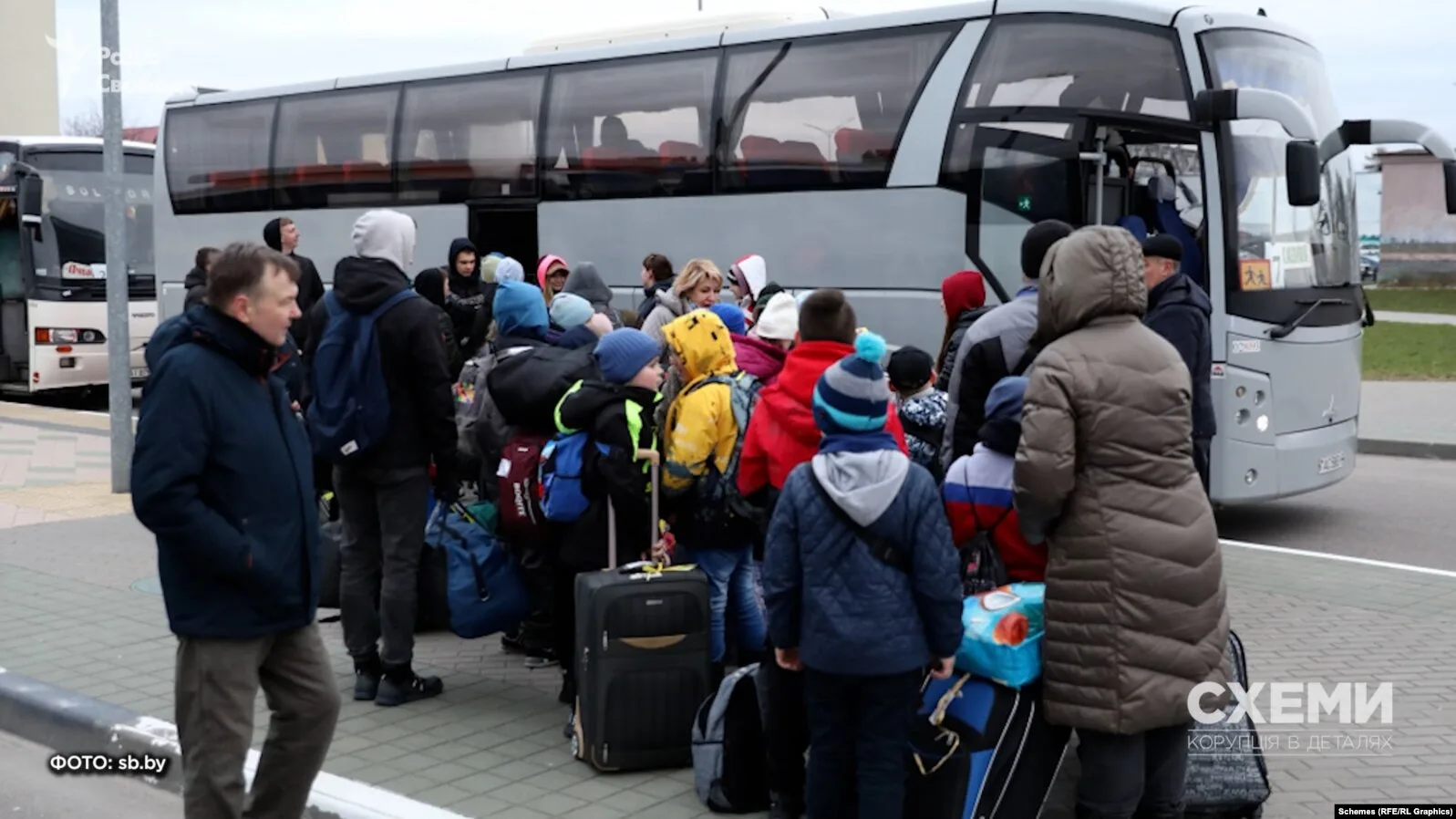
- Nature of the crime: deportation and forcible transfer of children from occupied territories of Ukraine to the Russian Federation and Belarus; enforced disappearances
- Period: at least since 24 February 2022, ongoing
- Identified by Ukraine: 19,546 children (the national “Children of War” registry)
- Verified by the UN Commission: more than 1,200 cases of deportation or transfer from five regions of Ukraine
- Documented by Yale HRL: a network of at least 210 facilities in Russia and occupied territories; re-education at 62.9% of them, military training at no fewer than 18% (report of 16 September 2025)
- Legal qualification: war crime (ICC arrest warrants of 17 March 2023) and crime against humanity (UN Commission, A/HRC/61/61, 12 March 2026)
- Named in the ICC warrants: Vladimir Putin, Maria Lvova-Belova
Why this is a separate crime, not a “consequence of war”
A civilian killed in a strike is a crime committed in seconds. The deportation of children works differently: it is an administered process, stretched over years, with a budget, agencies, reporting lines, transport logistics, and legal paperwork.
That is precisely why it is qualified separately. A missile can be blamed on a “targeting error.” A system in which a child is removed, registered, issued a passport, placed in an adoption database, and switched to the Russian school curriculum cannot be blamed on error — every step of it requires a decision by a specific official.
One legal detail is crucial: the forcible transfer of children of one group to another group is singled out as a distinct act of genocide in Article II(e) of the 1948 Convention on the Prevention and Punishment of the Crime of Genocide. The drafters understood that a group can be destroyed not only physically — but by taking away its next generation.
How the system works
Step 1. Selecting the vulnerable
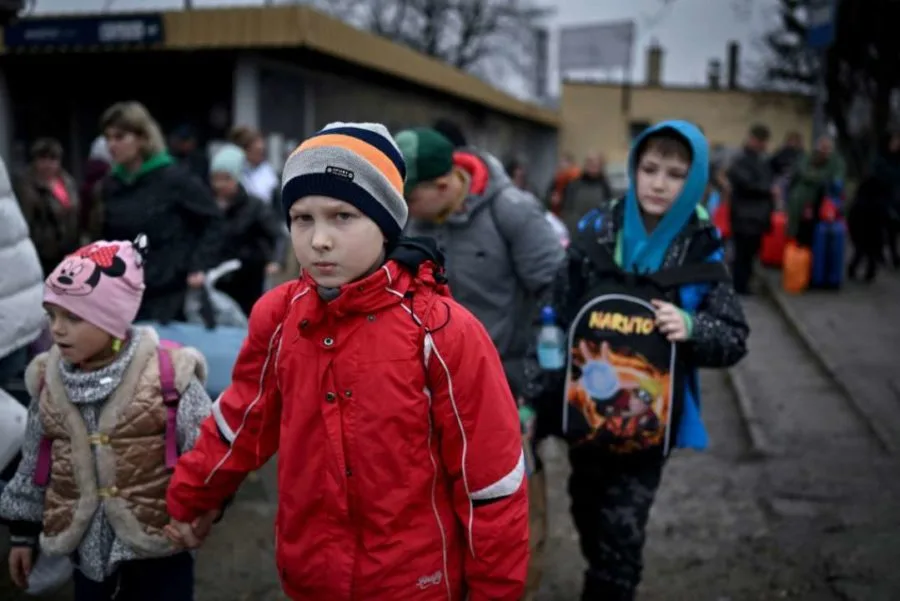
Yale Humanitarian Research Lab established that children were not taken indiscriminately: the system deliberately selected the most defenceless — orphans and children deprived of parental care, children with disabilities, children from low-income families, and children of military personnel.
This is fundamental to the legal assessment. Selection by vulnerability demonstrates advance planning, not spontaneous evacuation from under fire.
A separate category consists of children separated from their parents at “filtration”: the adult was detained for screening, the child was sent onward without them.
Step 2. Removal and dispersal
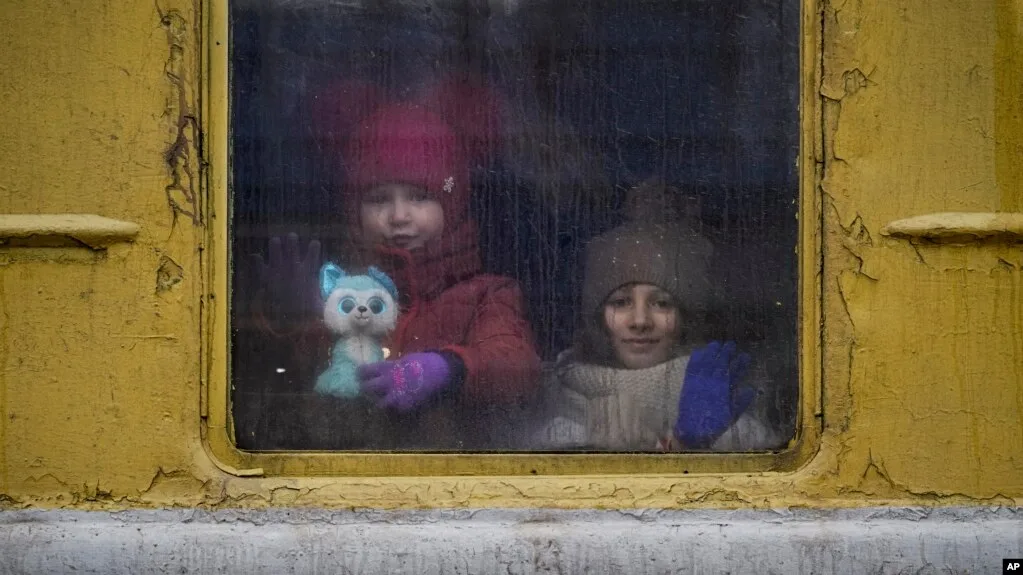
Children were taken through the occupied territories deep into Russia and into Belarus. The UN Commission established that they were placed across 21 regions of Russia and in occupied territories — in families and institutions, on a long-term basis.
Yale Humanitarian Research Lab, in its report of 16 September 2025, identified at least 210 facilities in Russia and the temporarily occupied territories of Ukraine. More than half of them are run by Russian state entities. Earlier Yale documentation also recorded facilities on the territory of Belarus.
The researchers describe this as a “potentially unprecedented system of large-scale re-education, military training, and dormitory facilities capable of holding tens of thousands of children.”
Dispersal across dozens of regions is not a logistical accident. It serves a specific purpose: it makes tracing and return practically impossible.
Step 3. “Re-education” and russification
The facilities run programmes designed to sever the child’s connection to Ukrainian identity: transfer to the Russian school curriculum, displacement of the Ukrainian language, “patriotic education,” and — in a number of documented cases — military training.
Yale HRL explicitly records a military component in the programmes of part of the network.
Step 4. Citizenship and adoption
The final stage is the legal entrenchment of the removal. The UN Commission established that Russian authorities granted deported and transferred children Russian citizenship and placed their profiles in adoption databases.
From that moment, in the eyes of the Russian legal system, the child ceases to be a citizen of Ukraine with a homeland, relatives, and the status of a protected person. He becomes “a Russian orphan awaiting a family.”
Tellingly, the Commissioner for Children’s Rights Maria Lvova-Belova personally took guardianship of a teenager from Mariupol — and spoke about it publicly. This is not a leak or an investigative finding: it is a voluntary public confirmation of the practice by its chief administrator.
Step 5. Enforced disappearance
The UN Commission separately qualified the conduct of the Russian authorities as enforced disappearance: information on the children’s whereabouts was systematically withheld from parents and guardians, and the conditions created made family reunification practically impossible.
Russia has not handed over lists of the removed children to the Ukrainian side, although it is obliged to do so under international humanitarian law.
Russia’s position
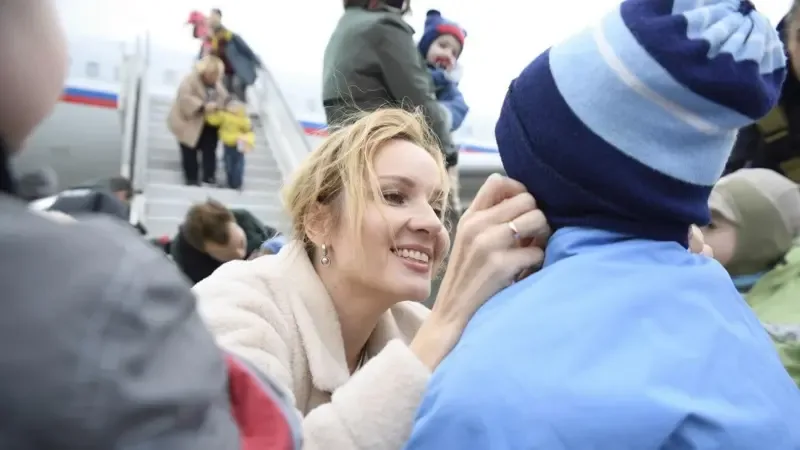
The official Russian position rests on a single claim: what is happening is not deportation but a humanitarian evacuation of children from a combat zone, the rescue of orphans, an act of mercy.
In July 2023, the Commissioner for Children’s Rights, Maria Lvova-Belova, stated that since February 2022 Russia had “received” more than 700,000 Ukrainian children (among some 4.8 million arrivals from Ukraine) — presenting this as a humanitarian mission. She claimed that “the overwhelming majority” of the children had arrived with parents or relatives, offering no evidence.
Legally, the position reduces to three assertions:
- the children were removed for their own safety;
- these are orphans with no parents;
- citizenship and placement in families is care for children left without guardianship.
The evidence
1. An “evacuation” with no return is not an evacuation
By definition, evacuation is temporary, presumes return at the first opportunity, and requires active facilitation of family reunification.
The UN Commission established that four years after the start of the full-scale invasion, 80% of documented cases remain unreturned.
Of the 19,546 children identified in Ukraine’s “Children of War” registry, only about two thousand have come home — and almost every return required international mediation rather than assistance from the Russian authorities. Qatar’s mediation returned 83 children; US efforts returned 26 (as of early April 2026).
A mechanism under which a child is not returned for years, and whose tracing requires the involvement of third states, is not an evacuation under any legal definition.
2. Most of the removed children are not orphans
The claim that “these are orphans” is refuted by the very structure of the Ukrainian registry: a substantial share of the children entered in it have living parents, guardians, or close relatives who are searching for them.
In Ukrainian law, the status “child deprived of parental care” does not mean the absence of parents — it can be assigned temporarily, with parental rights preserved. Russia treated this status as “orphan” and used it as grounds for placement in Russian families.
In addition, some children were separated from living parents during the process itself — at filtration procedures.
A separate mechanism: the “two-week camp.” In the occupied territories, parents were told that fighting was about to begin and it was unsafe for children to stay, and were offered to send them to Crimea — to rest and continue their schooling. Return was promised in two weeks. No one brought anyone back.
This matters fundamentally for the legal assessment: these children have not merely living parents, but parents who handed the child over themselves, having been misled as to the duration and purpose. Consent obtained by deception is not consent. And failure to return by the promised date turns a “recreational trip” into detention.
How imposed citizenship blocks return. The case of a child from the boarding school in Oleshky is instructive: the grandmother who came for him had all the necessary documents. The occupation authorities first demanded a DNA test, and then declared that they could not “give a Russian child to a foreigner” — since the child had already been forcibly granted Russian citizenship.
This is exactly how the mechanism described above works: citizenship is issued without consent and then used as legal grounds to refuse a relative the return of their own child.
3. Citizenship and adoption databases prove intent
If the aim were to protect a child temporarily, that does not require changing their citizenship and placing their profile in an adoption database.
It is precisely these two actions — established by the UN Commission — that move the situation from the category of “contested humanitarian practice” into that of deliberate removal: they are aimed at irreversibility, at legally cementing the child’s severance from Ukraine.
4. A network of 210 facilities proves systematicity
A one-off removal can be explained by the chaos of war. 210 facilities, more than half of them run by state entities, with a common “re-education” programme, funding, and reporting, constitute infrastructure.
Infrastructure does not arise spontaneously. It is designed, funded, and managed. Yale HRL states directly that the programme was authorised at the highest level and executed by federal, regional, and occupation officials.
5. Selection by vulnerability
If this were about rescue from shelling, children would have been removed from the most dangerous areas regardless of social status. Instead, selection followed the criterion of legal defencelessness — those with no one to stand up for them and whose status was easiest to re-register.
Violence, militarisation, and the children of servicemen
This is a section where it is especially important to separate what is documented from what is assumed. Below is what the sources confirm — and, separately, what has no confirmation.
Children of Ukrainian servicemen as a target category
This is confirmed. Among the groups the Russian side deliberately selected for removal, Yale HRL explicitly names — alongside orphans, children with disabilities, and children from low-income families — children whose parents serve in Ukraine’s armed forces.
Selection on this basis has independent legal significance: it shows that the criterion was not the risk to the child’s life but the status of the child’s parents. The child of an enemy serviceman never becomes a lawful target under any circumstances — their removal cannot be explained by humanitarian considerations even hypothetically.
What we cannot assert. In the available materials of the UN, Yale HRL, and human rights organisations, no documentation was found showing that children of Ukrainian servicemen were treated worse than others — that is, punitively, specifically because of their parents’ service. Selection into this category is documented; differentiated persecution within the system is not. We record this as an open question, not as a fact.
Militarisation: “the next generation of Russian soldiers”
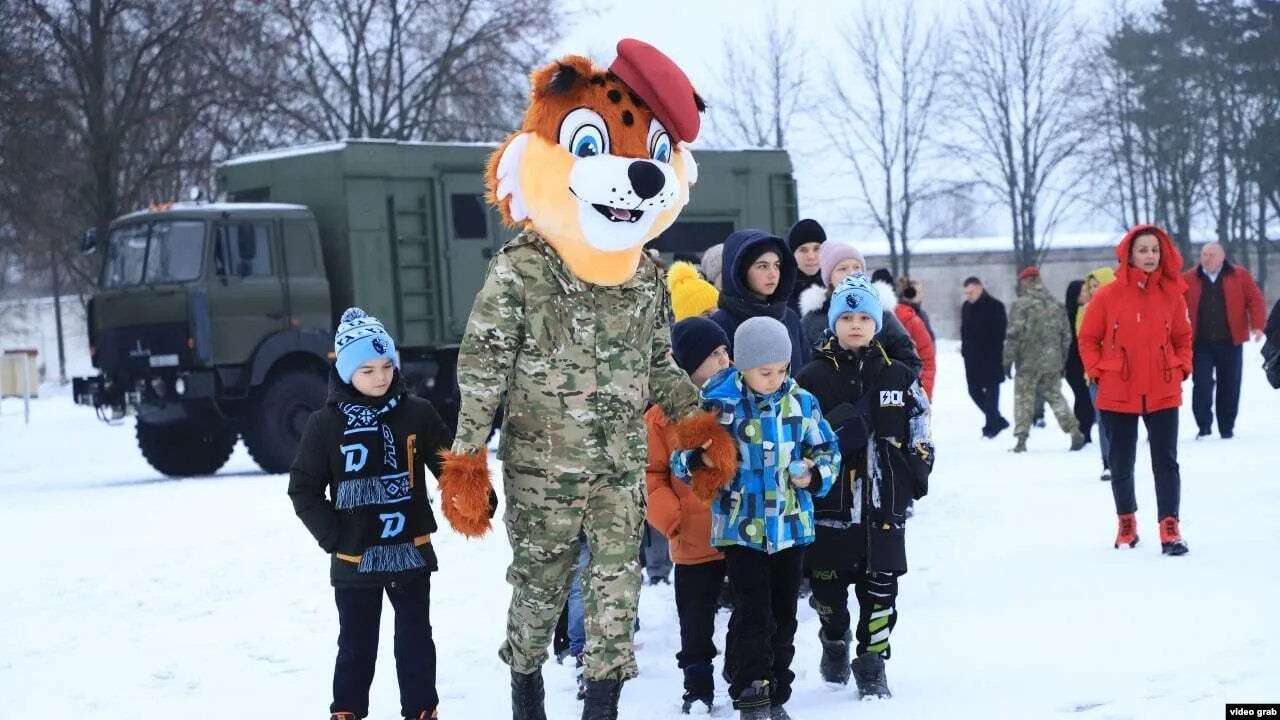
Military training is documented as a standard element of the system, not an excess: according to Yale HRL, it is conducted at no fewer than 18% of the 210 facilities.
Ukraine’s human rights commissioner states the purpose bluntly: the main goal of the deportation is to use these children as the next generation of Russian soldiers.
Here a separate offence arises. This is no longer only about transfer, but about preparing the children of an occupied state for military service in the occupier’s army. International humanitarian law prohibits an occupying power from compelling the population of occupied territory to serve in its armed forces; applied to children, this is compounded by the norms protecting children in armed conflict.
The logic of the system closes here: the child is removed, stripped of language and identity, given Russian citizenship — and prepared to fight against the country he was taken from.
Violence and conditions
The following is documented:
- Yale HRL records cases in which children were subjected to physical abuse, denied contact with their families in Ukraine, and given inadequate food and care.
- The UN Commission established that arbitrary detention, torture, and other ill-treatment occurred at filtration procedures.
- In the facilities themselves, witnesses describe poor living conditions, inadequate care, and verbal abuse.
- Returned children describe trauma, fear, and anxiety — persistent consequences requiring long-term rehabilitation.
Deaths: what is known and what is not
This is the gravest and, at the same time, the most sparsely documented question.
One case is known. In October 2022, eleven children were removed from a boarding school in Oleshky (a suburb of Kherson). Of these, three were placed in institutions in Moscow, seven were subsequently returned to Ukraine, and one child is reported to have died.
Absolute precision is required here: the circumstances of that death have not been disclosed. There is no information on the cause, and none on whether it was connected to violence, inadequate care, or illness. To assert anything beyond the bare fact would be to go past what is proven.
No systematic accounting exists. This is the key circumstance. Russia does not hand over lists of removed children to Ukraine and systematically conceals their whereabouts — meaning that the very structure of the crime makes counting deaths impossible. The absence of documented cases here is not evidence of their absence: it is a consequence of the system’s opacity.
We deliberately leave this section incomplete. Filling the gap with conjecture on a subject where the count is measured in children’s lives would mean adopting the methods of the side we are examining.
Debunking the propaganda
Myth: “We were saving children from the war”
Refutation: saving a child from war does not require changing their citizenship, placing them in an adoption database, concealing their whereabouts from their parents, and refusing to hand lists to Ukraine. All four actions are documented by the UN Commission. Each of them is aimed not at returning the child, but at preventing return.
Myth: “They are orphans, they have no one”
Refutation: a substantial share of the children have living parents or relatives searching for them — it is their appeals that populate the Ukrainian registry. The Russian side used the Ukrainian legal status “deprived of parental care” (which is not the same as orphanhood) as grounds for placement in Russian families.
Myth: “The children themselves wanted to stay in Russia”
Refutation: the consent of a child held under the full control of the party that removed them, cut off from family, after a “re-education” programme and without access to independent information, has no legal weight. International law expressly excludes the possibility of voluntary consent under coercion and occupation. Moreover, the UN Commission documented conditions that in themselves preclude free choice: concealment of whereabouts and the impossibility of contact with family.
Myth: “We received more than 700,000 children, mostly with their families — it is humanitarian aid”
Refutation: first, the figure itself is not a justification but an admission of scale: the more children Russia says it has “received,” the larger the phenomenon in question. Second, the claim that “the overwhelming majority arrived with their parents” was backed by Lvova-Belova with nothing — and it does not cancel the documented cases in which children were removed without their parents, granted Russian citizenship, and placed in adoption databases. Third, were this genuinely a humanitarian reception, Russia would have handed Ukraine the lists of these children and a mechanism for their return — which has not been done.
Myth: “The West is inflating this for the sake of sanctions”
Refutation: the conclusions were reached not by journalists but by two independent institutions with different mandates and methodologies: the International Criminal Court (judicial assessment of evidence, arrest warrants) and the UN Commission of Inquiry (a Human Rights Council mandate, field verification). To these is added the academic documentation of Yale HRL, built on satellite imagery and open Russian sources — including public statements by Russian officials themselves.
Legal qualification
The International Criminal Court: arrest warrants
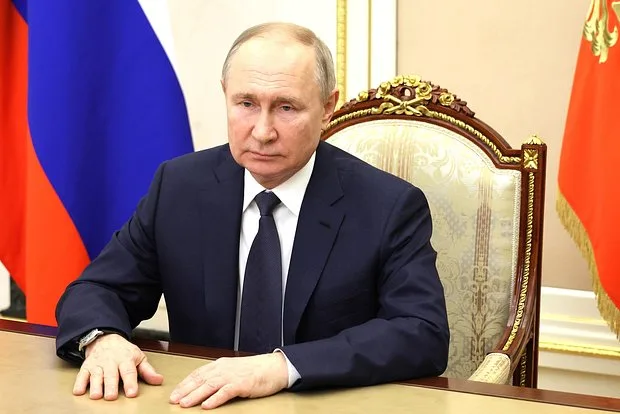
On 17 March 2023, Pre-Trial Chamber II of the ICC issued arrest warrants for Vladimir Putin and Maria Lvova-Belova.
- Charges: the war crime of unlawful deportation of population (children) and unlawful transfer of population (children) from occupied areas of Ukraine to the Russian Federation
- Rome Statute articles: 8(2)(a)(vii) and 8(2)(b)(viii)
- Mode of liability: article 25(3)(a) — committing the acts directly, jointly with others, and/or through others
- Period: at least since 24 February 2022
This is the first ICC warrant in history against a sitting head of state — a permanent member of the UN Security Council.
The UN Commission: crime against humanity
On 12 March 2026, the Independent International Commission of Inquiry on Ukraine published report A/HRC/61/61 (with the accompanying conference room paper A/HRC/61/CRP.8), concluding that the deportation and forcible transfer of Ukrainian children, as well as their enforced disappearance, amount to crimes against humanity.
The Chair of the Commission, Erik Møse:
“The deportation and forcible transfer of children is a grave violation of international law.”
The Commission established that this is a state policy, implemented through federal and regional authorities, with the involvement of President Vladimir Putin and Commissioner for Children’s Rights Maria Lvova-Belova.
The legal significance of this qualification is substantial: a “crime against humanity” requires proof of a widespread or systematic attack against a civilian population and of the perpetrator’s knowledge of it. In other words, the Commission found established not isolated episodes, but a policy.
The Genocide Convention
Article II(e) of the 1948 Convention lists the forcible transfer of children of one group to another group among the acts of genocide — where there is intent to destroy the group as such.
The Parliamentary Assembly of the Council of Europe and the parliaments of a number of states have qualified the deportation of Ukrainian children as evidence of genocide. A distinction must be drawn: a political or parliamentary qualification is not equivalent to a judicial finding — the question of genocide is for a competent court to determine.
Those responsible
| Level | Person / body | Role |
|---|---|---|
| Highest | Vladimir Putin | ICC warrant; decrees easing citizenship and placement of children; authorisation of the programme (Yale HRL) |
| Administration | Maria Lvova-Belova | ICC warrant; Commissioner for Children’s Rights; publicly confirmed personally taking guardianship of a child from Mariupol |
| Federal | Relevant Russian agencies | Citizenship, guardianship and custody, placement of profiles in adoption databases |
| Regional | Authorities of 21 Russian regions | Reception, accommodation, placement of children in families and institutions |
| Occupation | Administrations of occupied areas | Initial selection, paperwork, removal |
Under the principle of command responsibility (article 28 of the Rome Statute), liability extends along the whole chain — from the direct perpetrator to those who exercised effective control and failed to prevent the crime.
The return of the children
Returns proceed slowly and almost exclusively through third parties:
- Qatar — mediation, 83 children returned (as of early April 2026)
- United States — 26 children; in March 2026 a $25 million programme to support return and rehabilitation was announced
- The Vatican, South Africa, and several European states — individual cases of mediation
- Bring Kids Back UA — Ukraine’s state initiative for tracing and return
The total number returned is on the order of two thousand children (estimates by the European Commission and Yale HRL differ depending on the date and counting method). That is about one tenth of the number merely identified — and a negligible fraction of the real scale.
The human dimension
On the nature of this section. Everything above consists of documents, verified data, and legal qualifications. This section is built differently: it gathers direct speech, testimony, and assessments — what does not fit into dry facts, but without which the substance of what is happening cannot be understood. Factual statements remain sourced; the selection of material and its interpretation reflect the author’s position.
Filipp’s story: a deportation described by its organiser
The most detailed account of how the system works was left not by a victim or an investigator, but by Maria Lvova-Belova herself — publicly, voluntarily, and as an achievement.
It concerns a teenager from Mariupol, Filipp Holovnia. Journalists from the “Skhemy” project (Radio Liberty) and Meduza reconstructed his path:
- Filipp’s mother died in 2017, but he had legal guardians in Ukraine — Serhii Holovnia and Iryna Kalatalova, who had not gone anywhere and were in Mariupol;
- in April 2022, when the boy came to a humanitarian aid distribution point, he was taken to Donetsk;
- then came a hospital, a facility of the occupation administration, and on 27 May 2022 he was brought, together with roughly thirty other Ukrainian children, to a dacha outside Moscow;
- there the Commissioner for Children’s Rights “found” him and took him into guardianship. Filipp became her tenth child.
The key fact: this is not an orphan. The child had living guardians, lawfully appointed by the Ukrainian state — and this is not a supposition by investigators but a fact they established. The entire “we were saving orphans” construction breaks against a single biography.
Lvova-Belova went on to describe the process in her own words. According to her accounts cited in Russian publications, the boy did not want to go to Russia, was angry at Moscow, read Ukrainian websites, and “constantly sang Ukrainian songs.” She explained his attachment to his own country by “eight years of anti-Russian propaganda” and called it an adolescent problem, then asked him to change his attitude towards Russia — for her sake.
She acknowledged that “not everything goes smoothly.” And she took pride in the outcome: over time the boy stopped wanting to return to Mariupol and began calling her mother. The outlet Verstka also recorded a detail that speaks for itself: the teenager replaced his avatar of a Ukrainian figure with a portrait of Alexander Dugin.
Consider the structure of this account. A child was taken out of a city being destroyed, where his lawful guardians remained. His longing for home was labelled a symptom of propaganda. His language, his songs, and his attachment to his homeland were consistently displaced. The success of this work was reported publicly.
This is a description of a crime, made by its organiser and presented as a love story. That is why, in the case of the deportation of Ukrainian children, the weightiest witness for the prosecution turned out to be the accused.
Parents who know where their children are
Filipp’s story is legally impeccable, but it has a limit: he had guardians, not living parents. The objection is easy — “still, not a mother.”
That is why another category of cases matters more: children who have living mothers and fathers who know exactly where the child is — and cannot get them back.
How it happened. In the occupied territories, parents were told: fighting is about to start, it is dangerous for the child here, send them to Crimea — they will rest, continue their schooling, and come back in two weeks. Parents agreed — not out of indifference, but precisely out of fear for their child, under shelling, without electricity or communications.
Two weeks later, no one came back.
What followed is what the UN Commission qualified as enforced disappearance: the child’s whereabouts were not disclosed to the parents, contact was restricted, and direct enquiries were met with refusal or silence.
The mothers who went themselves. Having waited in vain for states to help, some parents set off for their children in person. The route, documented by journalists at PBS NewsHour and the Pulitzer Center, runs like this: from Kyiv by train to Chełm (Poland), by bus to Minsk, by plane to Moscow, and then by bus and car to Crimea or the occupied territories. Roughly five thousand kilometres around the front line, through the territory of the aggressor state, alone, towards the people holding your child.
The organisation Save Ukraine (Mykola Kuleba), which accompanies such journeys, has helped return more than two hundred children.
And here is the detail that devalues the entire Russian version: when a mother made it there, the children were handed over without resistance. Children ran to mothers they had not seen for months.
Consider what that means. If a child is an orphan, there is no basis for handing them to a woman who turns up. If this is a “rescue,” then returning the rescued child home should not require a five-thousand-kilometre journey through three countries. The system released children precisely when an adult physically arrived and was willing to take the risk — and held on to all the rest.
When arriving is impossible. Not everyone has that option. The grandmother of the child from the Oleshky boarding school did make the journey and brought a complete set of documents — she was required to take a DNA test, and was then refused on the grounds that they would not “give a Russian child to a foreigner.”
Harder still is the case of Artem and Sofia: in the autumn of 2024 their mother Mariia was taken away by unidentified masked men, and in early 2026 a Russian court sentenced her to 10 years’ imprisonment for “espionage.” The parent who could have come for the children ended up imprisoned herself.
This is the answer to why only about a tenth even of those identified have been returned. Not because there are no parents. But because searching for one’s own child has been turned into a task only a few can manage.
What the children say
Testimony obtained by the UN Commission describes poor living conditions, inadequate care, and verbal humiliation. But what recurs most often in the accounts is not physical violence — it is the methodical displacement of belonging: bans on speaking Ukrainian, “patriotic” classes, military training, explanations that their own country had abandoned them.
The formulation of the goal to which all these practices reduce was put most precisely by The New York Times: Russian officials made it clear that their task is to replace any childhood attachment to home with a love for Russia.
Systematised testimony from teenagers in the occupied territories has been collected by The Reckoning Project, an international team of journalists and lawyers. It formed the basis of the documentary “Children of the Occupation: Donetsk, Mariupol, Crimea” (premiered 31 January 2025), in which those who lived through “re-education,” militarisation, and forced displacement speak for themselves.
A separate, rarely discussed part is the return. Children come home after months or years spent in an environment where they were told their country was the enemy. Many return with a different language, different holidays, and a sense of guilt towards both sides. Rehabilitation here is not a metaphor: it is years of work, and it is precisely what programmes such as Bring Kids Back UA are aimed at.
The voices of researchers and human rights defenders
Yale Humanitarian Research Lab, which documented the network of facilities, states its conclusion without diplomatic hedging:
“The kidnapping and indoctrination, including military training, of children from Ukraine was ordered by Russia’s President Vladimir Putin and executed by Russia’s federal, regional, and occupation officials.”
The Chair of the UN Commission of Inquiry, Erik Møse, was more restrained, but no softer:
“The deportation and forcible transfer of children is a grave violation of international law.”
The difference in tone matters more than the similarity: an academic study and a mandated UN commission, proceeding by different routes and different standards of proof, arrived at the same address of responsibility.
The world’s reaction
On 27 April 2023 the Parliamentary Assembly of the Council of Europe adopted a resolution recognising the deportation and forcible transfer of Ukrainian children as evidence of genocide. The vote: 87 in favour out of 89 present, one against, one abstention.
PACE referred directly to Article II(e) of the 1948 Convention and pointed to documented indicators of russification: bans on speaking Ukrainian, propaganda, trips to “patriotic” events, and military training.
President Volodymyr Zelensky called this the first recognition of the fact at the level of such a high international organisation uniting the states of the continent.
To this are added:
- personal sanctions against Maria Lvova-Belova by the EU, the United States, the United Kingdom, and other states;
- a US programme of $25 million (March 2026) for the return and rehabilitation of displaced Ukrainian children;
- mediation by Qatar, the Vatican, and South Africa — states that maintain channels to Moscow;
- resolutions of national parliaments in a number of countries qualifying the deportation of children as evidence of genocide.
An important caveat: a political or parliamentary qualification of genocide is not equal to a judicial finding. Legally, the question of genocide remains open and is for a competent court. But the political consensus here is unusually broad — 87 out of 89.
Conclusion
The deportation of Ukrainian children differs from the other documented crimes of the Russian invasion in that it cannot be explained by chance, error, or the excess of an individual perpetrator.
Every element of it — selection by vulnerability, removal, dispersal across 21 regions, a network of 210 facilities, a “re-education” programme with military training, the granting of citizenship, the placement of profiles in adoption databases, the concealment of whereabouts from parents, and the refusal to hand over lists — constitutes an administrative decision by a specific official.
It is precisely this systematicity that two independent institutions recorded: the ICC, by issuing arrest warrants, and the UN Commission, by qualifying the conduct as a crime against humanity and naming it outright as state policy.
The Russian version of a “humanitarian evacuation” is refuted not by value judgements but by the actions of the Russian side itself: an evacuation does not involve changing a child’s citizenship, placing them in an adoption database, and refusing to tell their parents where they are.
Legal status
| Body | Status | Details |
|---|---|---|
| International Criminal Court | Arrest warrants issued | 17.03.2023 — Putin and Lvova-Belova; arts. 8(2)(a)(vii), 8(2)(b)(viii), 25(3)(a) of the Rome Statute |
| UN Commission of Inquiry | Crime against humanity | Report A/HRC/61/61 and A/HRC/61/CRP.8 of 12.03.2026 |
| Genocide Convention | Evidence of genocide (art. II(e)) | Political qualification by PACE and several parliaments; no judicial finding |
| Ukraine | Criminal proceedings | Art. 438 of Ukraine’s Criminal Code; national “Children of War” registry |
| EU / US | Sanctions and return programmes | Personal sanctions against Lvova-Belova; US $25 million programme (March 2026) |
Case timeline
| Date | Event |
|---|---|
| From 24.02.2022 | Systematic removal of children from occupied territories begins |
| May 2022 | Decree easing the granting of Russian citizenship to Ukrainian children and their placement in families |
| February 2023 | Yale HRL publishes the first documentation of the “re-education” network |
| 17.03.2023 | The ICC issues arrest warrants for Putin and Lvova-Belova |
| 27.04.2023 | PACE recognises the deportation of Ukrainian children as evidence of genocide |
| July 2023 | Lvova-Belova claims Russia has “received” more than 700,000 Ukrainian children |
| 2023–2025 | Return of individual groups of children through mediation by Qatar, the Vatican, South Africa |
| 16.09.2025 | Yale HRL: the network has grown to at least 210 facilities; military training at 18% of them |
| March 2026 | The US announces a $25 million programme for the return and rehabilitation of children |
| 12.03.2026 | The UN Commission (A/HRC/61/61) qualifies the conduct as a crime against humanity |
Further materials
Films and investigations
- Kyiv Independent — the documentary “The War They Play” on Russia’s system for abducting and indoctrinating Ukrainian children, through the eyes of those who lived through it (War Crimes Investigations Unit, October 2025)
- The Reckoning Project — the documentary “Children of the Occupation: Donetsk, Mariupol, Crimea” (2025)
- PBS NewsHour — “Ukrainian mothers take extreme measures to rescue kidnapped children” (video report)
- CBS News / 60 Minutes — the grandmother who travelled into occupied territory for her grandson (video)
- RFE/RL (Radio Svoboda) — “Dad, they want to adopt us”: abducted Ukrainian children in Russia (in Russian)
- BBC News Russian — “We can talk about 31,000 deported children”: an interview with the American investigating the removal of children from Ukraine to Russia (in Russian)
- Euronews — deported Ukrainian children are forced into military preparation in Russia (in Russian)
How to verify for yourself
- The national “Children of War” registry — the database of identified children and return statistics
- Yale Humanitarian Research Lab — satellite documentation of the facility network
- Bring Kids Back UA — the state platform for tracing and return
Sources
- International Criminal Court — arrest warrants for Putin and Lvova-Belova (17.03.2023)
- OHCHR — UN Commission: deportation and forcible transfer of Ukrainian children amount to crimes against humanity (12.03.2026)
- Yale School of Medicine / Humanitarian Research Lab — Fact Sheet: Russia’s Kidnapping and Re-education of Ukraine’s Children
- The national “Children of War” registry
- Bring Kids Back UA — Ukraine’s state initiative for the return of children
- European Commission — bringing Ukrainian children back home
- US Department of State — $25 million effort for the return and rehabilitation of children (March 2026)
- Just Security — Ukrainian Children Under Russian Control: Tracing, Return, Reintegration, Justice
- Meduza / “Skhemy” (Radio Liberty) — investigation into Filipp, who has legal guardians in Ukraine
- Verstka — Lvova-Belova on her adopted son from Mariupol
- Council of Europe — PACE: forcible transfer and russification of Ukrainian children shows evidence of genocide (27.04.2023)
- The Reckoning Project — documentary “Children of the Occupation: Donetsk, Mariupol, Crimea”
- Yale School of Public Health / HRL — “Ukraine’s Stolen Children: Inside Russia’s Network of Re-education and Militarization” (16.09.2025)
- JusticeInfo — “Ukraine: four years of systemic deportation of children”
- Euronews — deported Ukrainian children as future recruits for the Russian army (ombudsman’s statement)
- PBS NewsHour — “Ukrainian mothers take extreme measures to rescue kidnapped children”
- Pulitzer Center — rescued children settling back into life at home
- NBC News — Save Ukraine and Mykola Kuleba: the battle to return the children
- CBS News / 60 Minutes — the grandmother who travelled into occupied territory for her grandson
- EU Neighbours East — it is not only children who are deported: parents are taken hostage too
- European Parliament — resolution on the return of Ukrainian children (08.05.2025)
- The Moscow Times — Russian official (Lvova-Belova): more than 700,000 Ukrainian children transferred to Russia since the invasion began (July 2023)